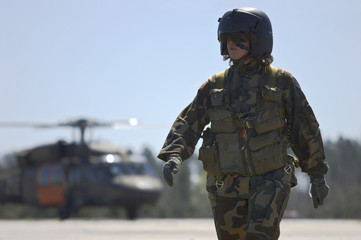
The US Military’s Engagement in Operation Desert Shield

An established presence in the Lexington, South Carolina business community. Having served as a pilot instructor and pilot with the US Air Force, Ricky Mantei completed three dozen combat missions, including a tour during Desert Storm.

According to an Air Force Magazine article, by 1990, Iraq under Saddam Hussein possessed the Arab world’s most advanced military. The consensus of the CIA, Pentagon, and State Department was that Iraq did not pose an urgent threat to Saudi Arabia and Kuwait, as its capabilities were spent from an extended engagement against Iran in the 1980s. Despite the Middle East’s increasing presence on the world stage since the 1970s, the region was still not considered as critical to US defense strategy within a Cold War context as the Pacific and European theaters.

This calculus changed overnight in August 2, 1990, when Saddam Hussein invaded Kuwait and seemed poised to broaden the attack into one that would threaten Saudi Arabia’s oil-rich Eastern Province. This compelled President George H. W. Bush to draw a line and demand Iraq’s immediate withdrawal from Kuwait, with the memorable quote, “This will not stand.” Accompanying this demand was the arrival, at Saudi King Fahd’s request, of several key military components. These included F-15s from Langley Air Force Base, a USAF C-141 for airlift control, and US Army 82nd Airborne Division elements.

The stage was set for Desert Shield, an operation that morphed into Desert Storm, in which the US Air Force would take a critical tactical role under the leadership of US Central Command and Army General H. Norman Schwarzkopf.

The Jet Provost – Decades of Service as RAF Trainer Aircraft

An alumnus of the United States Air Force Academy with a BS in civil engineering, Ricky Mantei has experience as a US Air Force F-16 pilot and owns a vintage Jet Provost.

The Jet Provost was employed by the Royal Air Force (RAF) as a jet-powered trainer from the mid-1950s to the early 1990s and exported by Britain to air forces across the globe. Originally developed by Hunting Percival, the aircraft built on the manufacturer’s success with its piston-engine Provost aircraft.

The affordable concept placed two seats side by side and underwent a four-year trial period with the RAF from 1955 to 1959. With the T Mk 1 Jet Provost’s seating configuration and handling amply proven, the RAF ordered 201 of the updated T Mk 3 model in 1959. This paired improved avionics with tip tanks, a clear canopy, and ejection seats by Martin-Baker.

Over the next decade, British Aircraft Corporation (BAC) took over manufacturing responsibilities, with more than 300 additional aircraft delivered to the RAF in 1967. Among these, approximately one-third were next-generation T Mk 4s, which increased thrust by 750 pounds. A roughly equal number were the T Mk 5 model that introduced a revamped windscreen, sliding canopy, pressurized cockpit, and extended nose. Equipped with machine guns on export models, the Jet Provost attained speeds of up to 440 mph and was the basis for the popular light-attack jet BAC Model 167 Strikemaster.

An Era Ends with the Passing of the Last of the Doolittle Raiders

Ricky Mantei has built up decades of experience and insight in his field, including his work as a top Merrill Lynch broker in the 1980s and 1990s. Ricky Mantei is also a veteran of the United States Air Force, participating each year in South Carolina’s Salute from the Shore Independence Day flyover tribute to American service members. In the time since his retirement, he has piloted military luminaries including members of the famous Doolittle Raiders, the airmen led by legendary Lt. Col. Jimmy Doolittle in a perilous 1942 raid against then-enemy Japan.

In 2019, the last of the 80 Doolittle Raiders, Lt. Col. Dick Cole, passed away at age 103. Cole was buried in Arlington National Cemetery.

Cole had served as Doolittle’s co-pilot in the Doolittle Raid, the American forces’ first counterattack against the Japanese mainland following the attack on Pearl Harbor. Launched on April 18, 1942, from the USS Hornet, more than 600 nautical miles out from their target, the 16 modified B-25B Mitchell bomber planes did little physical damage, but gave those back home in the United States a big boost of morale. The raid also marked the only time US aircraft bombers were launched into combat from an aircraft carrier.

In the years before his death, Cole had become a legendary and beloved figure in public life. Notably, he participated in a 2016 announcement at the Air Force Association’s Air, Space & Cyber Conference to reveal that the B-21, the new long-range stealth bomber, would be called “the Raider.”

A Salute to South Carolina Medical Professionals